Location
RRJG+RMF, Bamyan 160301, Afghanistan
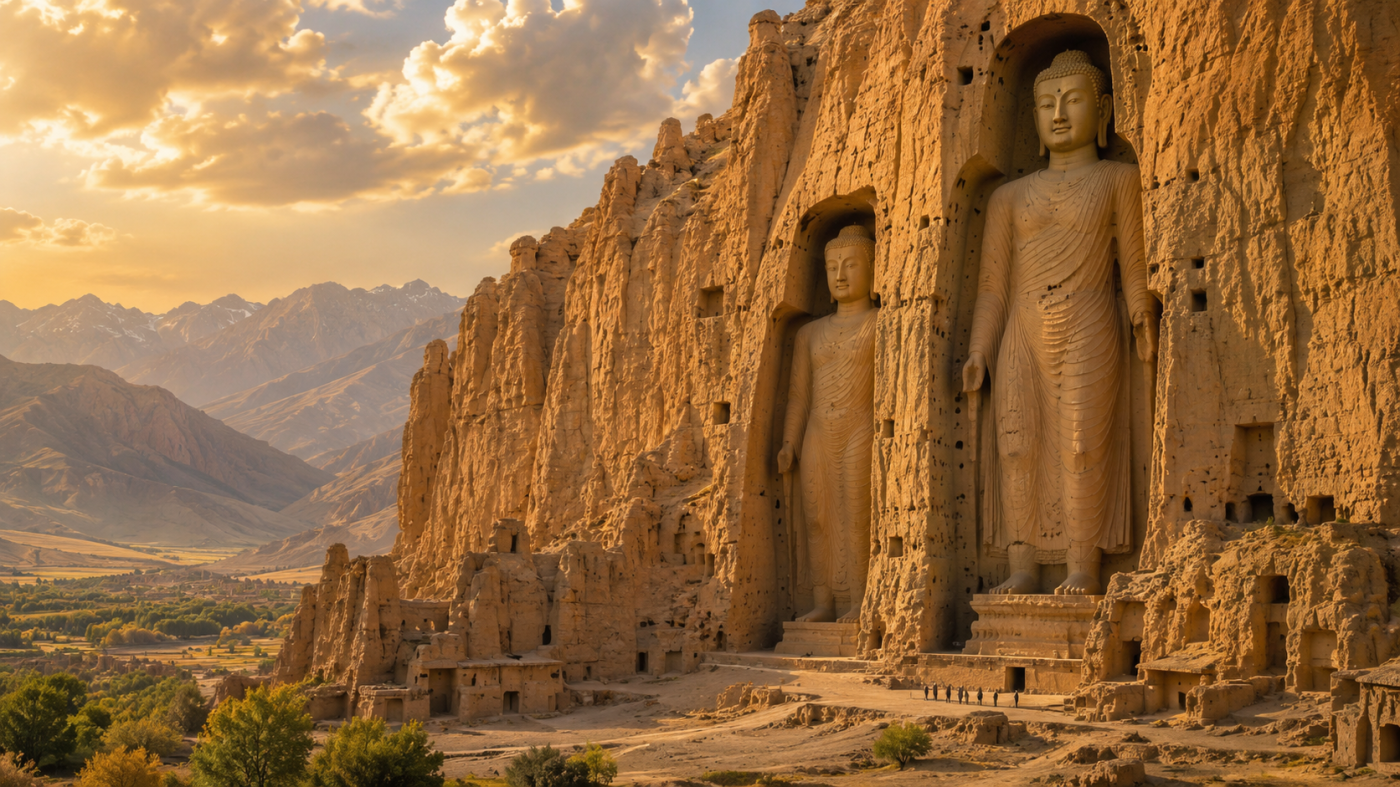
The Buddhas of Bamiyan were two enormous standing Buddha statues carved into the sandstone cliffs of the Bamiyan Valley in central Afghanistan. For more than 1,400 years, these monumental figures watched over an ancient landscape that once connected travellers, merchants, monks and cultures along the Silk Road.
Although the statues were deliberately destroyed in 2001, their empty niches remain among the most recognisable archaeological landmarks in Afghanistan. They continue to represent both the artistic achievements of the ancient world and the importance of protecting cultural heritage during conflict.
Where Is Bamiyan?
Bamiyan, also written as Bamyan or Bamian, is located in the mountainous central region of Afghanistan. The valley lies between high mountain ranges and historically served as an important stopping point on routes linking Central Asia, South Asia, Persia and China.
Its position made Bamiyan more than a remote settlement. It became a meeting place where religions, artistic traditions, languages and commercial networks interacted. Buddhist monks and pilgrims established monasteries and sanctuaries throughout the valley, transforming its cliffs into a major religious complex.
When Were the Buddhas of Bamiyan Built?
The two colossal statues were created around the sixth century, during a period when Buddhism was flourishing across parts of Afghanistan and Central Asia.
The larger western Buddha stood approximately 55 metres high, while the smaller eastern Buddha measured about 38 metres. Both figures were carved directly into the cliff face and positioned inside tall arched niches.
The statues were not isolated monuments. Hundreds of caves, chapels, meditation chambers and monastic spaces were carved into the surrounding cliffs. Many of these caves contained Buddhist paintings and decorative artwork.
Art Inspired by Different Civilisations
The artistic importance of Bamiyan came from its combination of cultural influences. Its monuments reflected traditions associated with Indian Buddhism, Central Asia, Persia and the wider Gandharan artistic world.
The flowing robes of the statues demonstrated how Buddhist art had absorbed ideas associated with Hellenistic and Roman sculpture. Other decorative elements reflected Sasanian and Indian influences. This mixture reveals how artistic styles travelled alongside merchants and religious communities on the Silk Road.
The Buddhas therefore represented more than two religious statues. They were physical evidence of communication between some of the ancient world’s greatest civilisations.
A Buddhist Centre on the Silk Road
For centuries, Bamiyan was an important Buddhist pilgrimage and learning centre. Monks lived in caves surrounding the statues, while travellers and pilgrims stopped in the valley during journeys across Asia.
The famous Chinese Buddhist monk and traveller Xuanzang visited Bamiyan during the seventh century. His accounts described a thriving Buddhist kingdom containing monasteries, monks and monumental religious images.
Bamiyan’s importance gradually declined as political authority, trade routes and religious traditions changed. However, the great statues continued to dominate the landscape long after Buddhism had largely disappeared from the region.
The Destruction of the Bamiyan Buddhas
In March 2001, the Taliban deliberately destroyed both statues. Artillery, explosives and other weapons were used against the monuments over several days, despite appeals from governments, religious leaders, historians and international organisations.
The destruction shocked people around the world. The Buddhas had survived changing empires, invasions, religious transitions and centuries of natural erosion, but they were ultimately reduced to fragments through a planned act of cultural destruction.
Their loss became a powerful example of how cultural heritage can be targeted during conflict. It also strengthened international discussions about protecting archaeological sites, monuments and museum collections threatened by war and extremism.
What Remains Today?
The two enormous niches remain visible in the Bamiyan cliffs, but the statues themselves have not been completely reconstructed. Fragments of the original sculptures survive around the site, together with caves, archaeological remains and historic wall paintings.
Conservation specialists have worked to stabilise damaged areas, protect surviving fragments and prevent sections of the cliff from collapsing. The process is technically difficult because the sandstone is fragile and the destruction caused serious structural damage.
There has also been an international debate about whether either statue should be rebuilt. Some experts support reconstruction as a symbol of recovery, while others believe the empty niches should remain as evidence of what happened in 2001.
A UNESCO World Heritage Site
In 2003, the Cultural Landscape and Archaeological Remains of the Bamiyan Valley was added to the UNESCO World Heritage List. It was simultaneously placed on the List of World Heritage in Danger because of structural instability, damaged archaeological remains, looting risks and other threats.
The protected landscape includes much more than the two Buddha niches. It contains Buddhist cave complexes, monasteries, sanctuaries, fortified structures and archaeological sites representing different chapters of Afghanistan’s history.
Why the Buddhas of Bamiyan Still Matter
The Buddhas of Bamiyan remain important even though the statues are no longer standing. Their surviving niches tell several interconnected stories: the spread of Buddhism, the development of Silk Road culture, the exchange of artistic ideas and the consequences of deliberately destroying heritage.
For Afghanistan, Bamiyan is evidence of a diverse past extending far beyond modern political conflicts. For the wider world, it is a reminder that cultural monuments belong not only to one country or generation but form part of humanity’s shared historical record.
The empty spaces in the cliffs now carry a meaning of their own. They represent what was created, what was lost and why the protection of cultural heritage remains an international responsibility.
Frequently Asked Questions
How many Bamiyan Buddha statues were there?
There were two principal colossal standing Buddha statues: a larger western statue measuring approximately 55 metres and a smaller eastern statue measuring approximately 38 metres.
Who destroyed the Buddhas of Bamiyan?
The Taliban deliberately destroyed both statues in March 2001 using explosives, artillery and other weapons.
Have the Bamiyan Buddhas been rebuilt?
No. The statues have not been completely reconstructed. Conservation work has concentrated on stabilising the niches, protecting fragments and preserving the surrounding archaeological landscape.
Why were the Bamiyan Buddhas important?
They were among the world’s largest ancient standing Buddha statues and demonstrated how Indian, Central Asian, Persian, Hellenistic and Roman artistic traditions interacted along the Silk Road.
Is Bamiyan protected by UNESCO?
Yes. The Cultural Landscape and Archaeological Remains of the Bamiyan Valley became a UNESCO World Heritage Site in 2003 and remains recognised as a heritage property requiring urgent protection.